
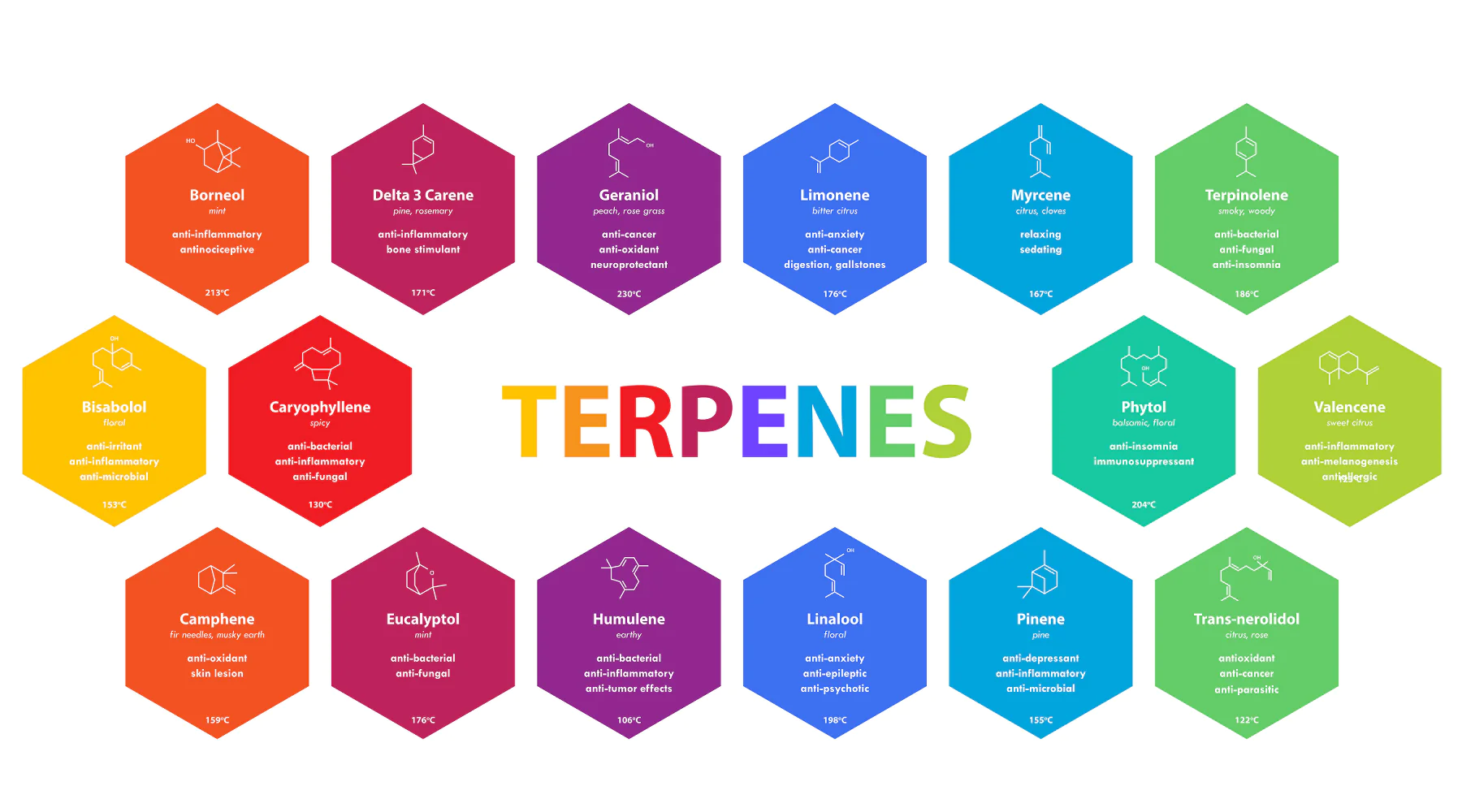
Two plants from the same seed can smell completely different. Same genetics, same nutrients, same light — and one comes out smelling like fuel and berries while the other smells like fresh-cut grass. That gap isn’t luck. It’s terpenes, and how well you treated them between harvest and the jar.
Terpenes are the aromatic compounds responsible for essentially every interesting smell and flavor cannabis produces. More than 200 different terpenes have been identified in cannabis so far — and unlike cannabinoids, they’re not unique to the plant. Myrcene comes from mangoes. Limonene comes from lemons. Linalool comes from lavender. Cannabis just happens to produce combinations of them that don’t exist anywhere else in the natural world, in concentrations high enough to genuinely affect how you feel.
This guide covers what every terpene does, which strains carry which terpenes in meaningful amounts, how they interact with THC and CBD, and — critically for growers — how to not destroy them between chop and cure.
What Terpenes Actually Are (And Where They Come From)
Terpenes are produced in the same glandular trichomes that produce THC and CBD. They’re synthesized from geranyl pyrophosphate — the same precursor cannabinoids come from — and they peak in production during late flower, roughly weeks 6–9 depending on the strain. That’s one of many reasons late-stage environmental conditions matter so much. If you’re running temperatures above 80°F in the last few weeks, you’re burning off terpenes before you ever get to harvest.
Chemically, terpenes are hydrocarbons built from repeating five-carbon units called isoprene. Monoterpenes (two isoprene units) like myrcene and limonene tend to be more volatile and aromatic. Sesquiterpenes (three isoprene units) like caryophyllene and humulene are heavier, less volatile, and often associated with the deeper earthy and spicy scent profiles. The difference in volatility is why some terpenes get cooked off more easily than others — both during growing and during the cure.
The Entourage Effect: Why Terpenes + Cannabinoids Together Outperform Either Alone
In 2011, cannabis researcher Ethan Russo published a landmark paper in the British Journal of Pharmacology that formalized what experienced users had been saying for decades: the whole plant works better than the sum of its parts. That “synergistic interaction” between cannabinoids and terpenes is what the industry now calls the entourage effect.
The basic idea is this: THC on its own hits differently than THC in the presence of myrcene, or limonene, or linalool. Terpenes don’t just add flavor — they appear to modulate how cannabinoids bind to receptors, how quickly they cross the blood-brain barrier, and which physiological pathways get activated. Linalool, for example, acts on GABA receptors — the same mechanism benzodiazepines use — which is why linalool-heavy strains tend to have an anti-anxiety, muscle-relaxing quality that pure THC isolate doesn’t replicate.
This is why whole-flower cannabis and full-spectrum extracts affect people differently than distillate. Distillate is pure THC — no terpenes, no minor cannabinoids. It gets you high, but it lacks the nuance. The terpene profile is what makes one strain feel creative and uplifting and another feel like it glued you to the couch.
The 10 Most Important Cannabis Terpenes
Myrcene — The Most Abundant Terpene in Most Strains
Myrcene is the dominant terpene in the majority of commercially grown cannabis strains — in many cases making up 50% or more of the total terpene content. It’s the reason OG Kush smells the way it smells: earthy, musky, slightly fruity, with that heavy dank note underneath everything. You’ll find myrcene in mangoes, thyme, hops, and bay laurel leaves.
The mango connection is more than trivia. Myrcene appears to increase cell membrane permeability in the blood-brain barrier, which is theorized to be why consuming mangoes before cannabis can amplify the effect. Whether you believe in that or not, the underlying mechanism — myrcene enhancing cannabinoid absorption — is a real area of ongoing research.
Effects: sedating, relaxing, the classic “couch-lock” quality is largely attributed to high myrcene content in combination with THC. Anti-inflammatory. Boiling point: 167°C (332°F) — one of the more volatile terpenes, which means it’s among the first to degrade when stored improperly.
Strains high in myrcene: OG Kush, Blue Dream, Granddaddy Purple, Mango Kush, White Widow.
Limonene — Citrus, Uplifting, Anti-Anxiety
Limonene is the second most common terpene in cannabis and one of the most recognizable by scent — it’s the bright, citrus smell in lemon rind, orange peel, and grapefruit. It’s also used as a natural solvent and cleaning agent, which gives you a sense of how potent and chemically active it is.
The research on limonene is legitimately interesting. It’s been studied for anti-anxiety effects, antifungal properties, and potential anti-tumor activity in cell studies. For practical purposes as a cannabis consumer, the more relevant point is that limonene-dominant strains tend to feel uplifting, mood-elevating, and energizing — the opposite of the myrcene couch-lock experience. Boiling point: 176°C (349°F).
Strains high in limonene: Wedding Cake, Durban Poison, Do-Si-Dos, Banana OG, Super Lemon Haze.
Caryophyllene — The Only Terpene That Acts Like a Cannabinoid
Beta-caryophyllene is unique among terpenes in one very specific way: it’s the only terpene known to directly bind to cannabinoid receptors — specifically the CB2 receptors found primarily in immune tissue. This has led researchers to formally classify it as a “dietary cannabinoid.” It doesn’t produce psychoactive effects, but its action on CB2 receptors makes it a potent anti-inflammatory compound.
The smell is spicy, peppery, and slightly woody. That’s because caryophyllene is also a major terpene in black pepper, cloves, cinnamon, and hops. If you’ve ever cracked black pepper and noticed it softened a too-intense THC experience, the caryophyllene interacting with your CB2 receptors is likely part of that. Boiling point: 199°C (390°F) — one of the more heat-stable terpenes.
Strains high in caryophyllene: GSC (Girl Scout Cookies), Chemdog, Sour Diesel, Original Glue (GG#4), Death Star.
Linalool — Lavender, Sedative, Works on GABA Receptors
Linalool is the dominant terpene in lavender, and it’s responsible for most of lavender’s well-documented calming, sleep-promoting effects. Cannabis strains with significant linalool content carry that same profile: floral, slightly spicy, with a very clear anxiolytic quality.
What makes linalool pharmacologically interesting is its mechanism. Research indicates it modulates GABA receptors — the same receptors targeted by benzodiazepines and alcohol. That’s why linalool has genuine sleep-promoting and anti-seizure properties that are distinct from THC’s sedating effect. It’s not just “relaxing” in a vague sense; it’s working on a specific receptor pathway. Boiling point: 198°C (388°F).
Strains high in linalool: Amnesia Haze, LA Confidential, Lavender, Zkittlez, Do-Si-Dos.
Pinene — Pine, Alertness, and a Counterbalance to THC
Alpha-pinene is one of the most abundant terpenes in nature — it’s the dominant compound in pine trees and the primary reason pine forests smell the way they do. In cannabis, pinene shows up as a clean, sharp, piney/herbal note underlying other aromas.
Here’s the grower-relevant detail: research suggests alpha-pinene inhibits acetylcholinesterase activity — which effectively counteracts THC-induced short-term memory impairment. High-pinene strains tend to feel clearer-headed and more functional than their THC percentage alone would suggest. Pinene is also a bronchodilator, which is one reason some people find pine-forward strains easier on the lungs. Boiling point: 155°C (311°F) — the lowest of the major terpenes, meaning it’s also the most volatile and most easily lost in improper storage.
Strains high in pinene: Jack Herer, Blue Dream, Strawberry Cough, Island Sweet Skunk, Cotton Candy Kush.
Terpinolene — Complex, Rare, and Found in Specific Elite Strains
Fewer than 1% of cannabis strains are terpinolene-dominant — but the strains that are tend to be among the most beloved by experienced consumers. Terpinolene has a complex, layered scent: piney up front, floral in the middle, slightly herbal finish. It’s found in apples, lilacs, nutmeg, and allspice.
Effects are typically described as uplifting and slightly sedating — a combination that doesn’t make obvious sense until you experience it. Terpinolene appears to have significant antioxidant properties and, per a 2013 study in Oncotarget, may inhibit cell growth in certain cancer cell lines. Boiling point: 185°C (365°F).
Strains high in terpinolene: Jack Herer, Ghost Train Haze, Golden Goat, Orange Cookies, Chernobyl.
Humulene — The Hops Terpene, Appetite Suppressant
Humulene is the compound that makes hops smell like hops — earthy, woody, with that characteristic hoppy bitterness. Cannabis and hops are botanical cousins (both in the Cannabaceae family), so it makes sense they’d share terpenes. In cannabis, humulene shows up as a deeper, earthier note rather than a dominant front-of-nose aroma.
The most notable property of humulene is appetite suppression — counterintuitive for a plant famous for causing munchies. High-humulene strains tend to produce less appetite stimulation than myrcene-dominant ones. Research also confirms anti-inflammatory and antibacterial properties. Boiling point: 106°C (222°F).
Strains high in humulene: Sour Diesel, White Widow, Skywalker OG, Headband, Pink Kush.
Ocimene — Sweet, Herbal, Antifungal
Ocimene has a sweet, herbaceous, slightly tropical scent — you’ll find it in mint, parsley, orchids, and a number of tropical fruits. It’s not typically a dominant terpene in cannabis, but in strains where it shows up in meaningful amounts, it creates that candy-like sweetness you smell in certain fruit crosses.
Beyond aroma, research has identified antifungal, antiviral, and decongestant properties. For the plant itself, ocimene functions as a defense compound — which explains why it might also be produced in response to environmental stress during the grow. Boiling point: 176°C (349°F).
Strains high in ocimene: Golden Goat, Strawberry Cough, Clementine, Space Queen, J1.
Bisabolol — Floral, Anti-Inflammatory, Underrated
Bisabolol is the primary terpene in chamomile and has a long history of use in cosmetics and skin care for its anti-inflammatory and skin-healing properties. In cannabis it contributes a delicate floral note — not overpowering, but distinctly present in strains where it shows up.
Research on bisabolol in cannabis is thinner than on the heavy hitters, but what exists confirms anti-inflammatory, antibacterial, and analgesic activity. It appears to enhance the absorption of other compounds — similar to the proposed mechanism for myrcene — which could mean it potentiates the entourage effect even at trace levels. Boiling point: 153°C (307°F).
Valencene — The Citrus Sativa Terpene
Named after Valencia oranges, valencene delivers a fresh, sweet citrus aroma that’s distinct from limonene’s sharper lemon quality. It tends to show up in sativa-dominant genetics — Tangie, Clementine, and similar strains that smell genuinely like fresh-squeezed orange juice rather than cleaning products. Anti-inflammatory, mosquito-repellent, and studied for potential anti-allergic properties. Boiling point: 122°C (252°F).
Terpene Profiles by Strain Type: What to Expect
Genetics largely determine terpene profile, but there are general patterns by strain lineage worth knowing before you grow or buy seeds:
OG Kush lineage (OG Kush, SFV OG, Ghost OG) runs heavy on myrcene and caryophyllene with notable limonene. That’s the classic fuel + earth + citrus nose. Expect sedating, heavy effects with an underlying spicy note.
Diesel and Sour families (Sour Diesel, Chemdog, East Coast Sour D) are caryophyllene and myrcene dominant with notable humulene. That’s where the rubber and diesel aroma comes from — the combination of heavy myrcene earthiness and caryophyllene’s pepper-clove character.
Cookie and Cake genetics (GSC, Wedding Cake, Ice Cream Cake) tend toward caryophyllene + limonene + linalool. That sweet + earthy + slightly spicy profile is characteristic of modern Cookies-derived crosses.
Fruit and candy strains (Runtz, Gelato, Zkittlez, Tangie) vary widely but often lead with limonene or ocimene for the sweet/fruity front note, myrcene in the middle, and either linalool or caryophyllene finishing it out.
Haze genetics (Super Silver Haze, Amnesia Haze, Neville’s Haze) tend toward terpinolene and linalool with supporting pinene. This combination produces that heady, complex spice-floral-pine character that old-school sativa users recognize immediately.
When Terpenes Are Made — and When They Peak
Terpenes are produced throughout the plant’s life cycle, but production accelerates dramatically in the last 4–6 weeks of flower. Peak terpene production typically coincides with — or comes slightly before — peak trichome development. By the time trichomes are fully milky, the plant has put its maximum terpene output into the resin.
A few environmental factors that directly affect terpene production during flower:
Temperature. Running your tent above 80°F (27°C) during late flower actively volatilizes terpenes — they literally evaporate into the air. This is one of the most common reasons a harvest smells weaker than the same genetics from a different run. Keep late-flower temps at 72–77°F maximum if you care about terpene retention.
Humidity. Moderate late-flower humidity — 45–55% RH — is associated with increased terpene production. The plant under slight stress produces more resin and more terpenes. Pushing humidity too low stresses the plant differently and can actually reduce terpene expression.
Light spectrum. UVB exposure in late flower has been associated with increased terpene and cannabinoid production. This is one reason some growers run supplemental UVB during the last 2–3 weeks. The science isn’t fully settled, but the anecdotal reports are consistent enough to take seriously.
Knowing when trichomes are at peak development — and harvesting at the right time — is essential before any of the post-harvest preservation work matters. If you haven’t dialed in harvest timing, our trichome guide covers the complete process.
How to Actually Preserve Terpenes After Harvest
This is the part most growers don’t think about enough — and it’s where the difference between a great cure and a mediocre one actually shows up in the jar. Terpenes are volatile organic compounds. They degrade fast when exposed to the wrong conditions, and most home growers unknowingly create exactly those conditions without realizing it.
Light is the biggest killer. UV light breaks down terpenes through photooxidation — the same process that degrades food color and nutrients in sunlight. Clear mason jars on a windowsill or under ambient light are genuinely problematic, not just aesthetically. The “hay smell” that develops in improperly cured cannabis is largely the smell of terpene degradation — volatile aromatics gone, leaving behind a grassy, chlorophyll-forward smell that shouldn’t be there.
Oxygen exposure accelerates oxidation. Terpenes — especially the highly volatile monoterpenes like myrcene and pinene — oxidize when continuously exposed to air. Proper burping technique during the cure manages oxygen exchange without letting the flower sit in a pool of stale air. After the first few weeks of active curing, many growers switch to airtight storage with minimal headspace.
Temperature matters in storage. Terpene degradation accelerates significantly above 70°F (21°C). This is why the recommendation to cure and store in a cool, dark space exists — it’s not just tradition. Cooler temps slow volatilization and oxidation simultaneously. The ideal curing environment is 60–70°F with 58–62% relative humidity.
The cure itself is where terpene expression develops. During the first 2–4 weeks of cure, enzymatic processes in the drying flower break down chlorophyll and convert precursors into their final aromatic compounds. A rushed cure — one week at low humidity under bright lights — doesn’t just dry the weed out. It skips the chemical transformation that produces the final terpene profile. “Wet” hay smells aren’t just surface moisture; they’re a sign the cure was cut short before the plant finished its own biochemistry.
The single most controllable variable is light. Blocking light from your curing jars completely — so UV never contacts the resin — is the easiest thing you can do to preserve terpene content across the entire cure. That’s exactly what Cure Sleeves are designed for: a blackout sleeve that fits over Ball wide-mouth mason jars and removes light degradation from the equation entirely. If you’re curing in glass jars — the best container for the job — this is the practical solution that doesn’t require rebuilding your storage setup.
For the full process on curing — proper humidity targets, timing, what to watch for week by week — our cannabis curing guide covers everything.
Frequently Asked Questions
What terpene is responsible for the classic “weed smell”?
Myrcene is the primary contributor to what most people recognize as the classic cannabis aroma — earthy, musky, dank. It’s the dominant terpene in most strains by percentage. Caryophyllene adds the spicy/peppery dimension, and limonene or pinene brighten it up depending on the strain. The combination of all three is what makes OG Kush smell like OG Kush.
Does the curing process affect terpenes?
Absolutely — it’s one of the most significant factors. A proper cure allows enzymatic conversion to complete, which actually develops and intensifies the final terpene profile. A rushed cure or one done in poor conditions (too warm, too bright, improper humidity) degrades terpenes rapidly. The difference in aroma between well-cured and poorly cured cannabis of the same genetics can be dramatic.
What’s the difference between terpenes and cannabinoids?
Cannabinoids (THC, CBD, CBG, etc.) are terpeno-phenolic compounds — chemically similar to terpenes but larger in molecular weight and structured to interact directly with the endocannabinoid system’s receptors. Terpenes are smaller, more volatile, and don’t primarily work through cannabinoid receptors — with one exception: caryophyllene, which binds directly to CB2 receptors. In practice, cannabinoids determine the ceiling of psychoactive and therapeutic effect; terpenes shape the character of that effect.
What terpene causes couch-lock?
Myrcene is most closely associated with the sedative, couch-lock quality in high-THC indica-dominant strains. The current theory is that myrcene enhances the permeability of the blood-brain barrier to THC, effectively increasing THC’s impact at a given dose. Linalool also contributes through its action on GABA receptors. Strains with very high myrcene combined with high THC are consistently the ones producing the heaviest physical sedation.
Does smoking temperature affect terpene experience?
Yes, significantly. Each terpene has a distinct boiling point — pinene vaporizes at 155°C (311°F), myrcene at 167°C, caryophyllene not until 199°C (390°F). Combustion in a joint or pipe reaches 800–900°C — far above every terpene’s boiling point, meaning most volatilize and combust before they reach you. Vaporizers set to 160–185°C preserve more terpene diversity than combustion, which is why the same flower can taste completely different through a vaporizer vs. a joint.
How can I get more terpenes out of my grow?
Keep late-flower temperatures at or below 77°F (25°C). Maintain 45–55% RH during final weeks. Consider a brief dark period of 24–48 hours before harvest — some growers report increased trichome density. Harvest at the right trichome stage rather than by the calendar. And most importantly: cure properly in a dark, temperature-controlled environment at 58–62% RH. You can grow the best-possible flower and lose 30–40% of its aromatic quality in the cure if you don’t treat the terpenes as carefully after harvest as you did during the grow.
🌱 Ready to put this into practice?
Get the right gear for your grow.
Everything covered in this guide is supported by purpose-built accessories — designed for home growers who take their cure seriously.